2Department of Orthopedics and Traumatology, Selçuk University Faculty of Medicine, Konya, Türkiye
Abstract
Objective: This study aimed to compare the perioperative, radiological, and clinical outcomes of arthroscopic pull-out suture fixation and double-loop cortical button fixation for anterior cruciate ligament (ACL) tibial eminence avulsion fractures.
Materials and Methods: This retrospective, two-center comparative study included patients who underwent arthroscopic fixation for ACL tibial eminence avulsion fractures between August 2022 and November 2024. Patients with modified Meyers and McKeever type IIIA or IIIB fractures and a minimum follow-up of 12 months were included. Patients were divided into two groups according to fixation technique: pull-out suture fixation and double-loop cortical button fixation. Demographic and perioperative variables, radiological union, Lysholm Knee Score, range-of-motion deficits, Lachman test results, and revision surgery were evaluated. Patients who underwent revision surgery were retained in the revision analysis, but post-revision clinical findings were excluded from the final comparison of clinical outcomes.
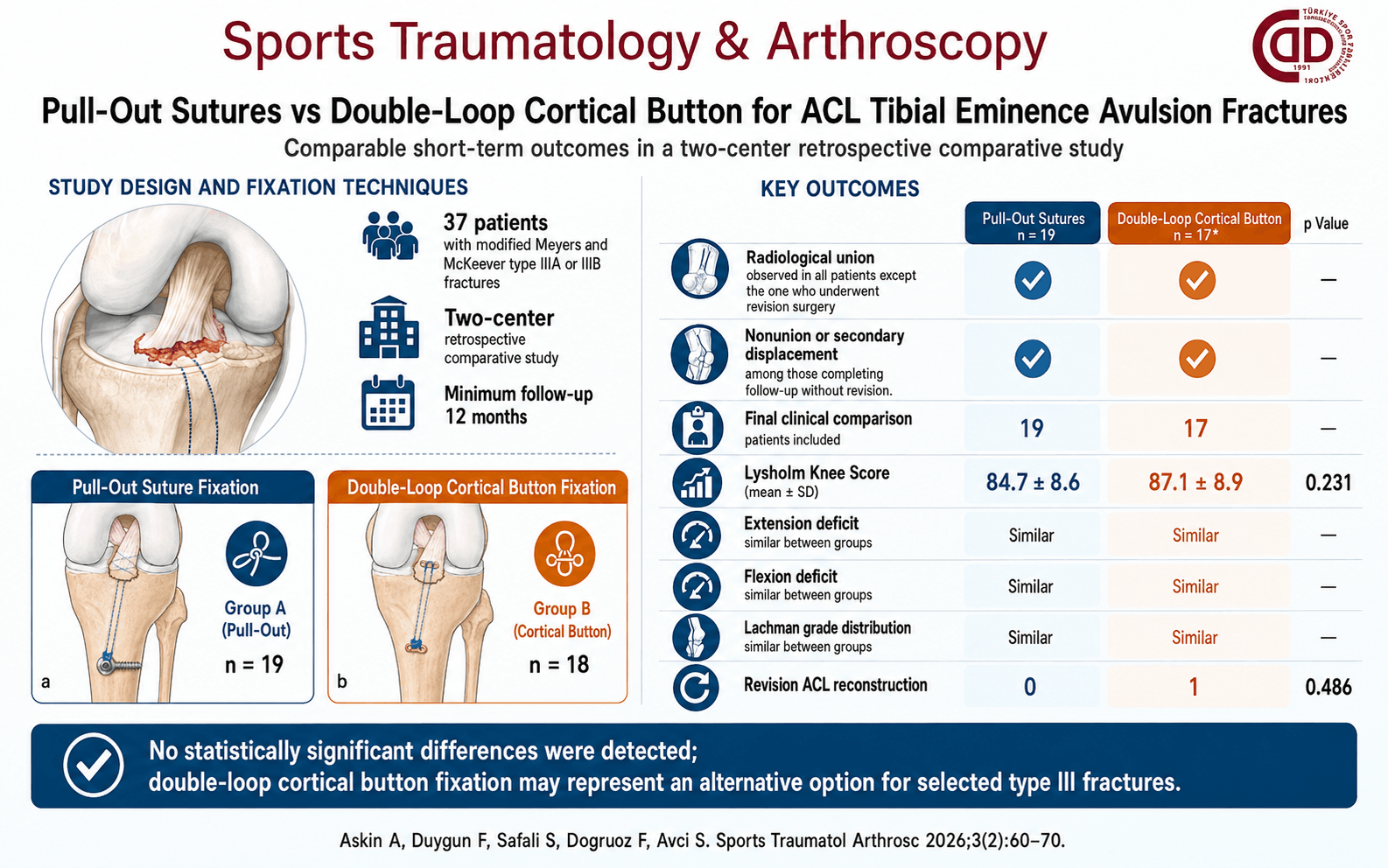
Results: A total of 37 patients were included: 19 in the pull-out suture fixation group and 18 in the double-loop cortical button fixation group. There were no significant differences between the groups in baseline characteristics, fracture type, time from injury to surgery, operation time, length of hospital stay, or follow-up duration. Radiological union was observed in all patients except the patient who underwent revision surgery, and no nonunion or secondary displacement was detected among patients who completed follow-up without revision. Final clinical outcomes were compared between 19 patients in the pull-out suture fixation group and 17 patients in the double-loop cortical button fixation group. The Lysholm Knee Score did not differ significantly between the groups (84.7±8.6 vs. 87.1±8.9, p=0.231). Extension deficit, flexion deficit, and Lachman grade distribution were also similar between the groups. One patient in the double-loop cortical button fixation group required revision ACL reconstruction, whereas no patient in the pull-out suture fixation group required revision (p=0.486).
Conclusion: No statistically significant differences were detected between arthroscopic pull-out suture fixation and double-loop cortical button fixation in the perioperative, radiological, and clinical outcomes evaluated in this cohort. Given the small sample size, these findings should not be interpreted as demonstrating equivalence between the two techniques. Double-loop cortical button fixation may represent an alternative fixation option for selected type IIIA and IIIB fractures.
Graphical Abstract