2Department of Anesthesiology and Reanimation, Şeyh Edebali University School of Medicine, Bilecik, Türkiye
Abstract
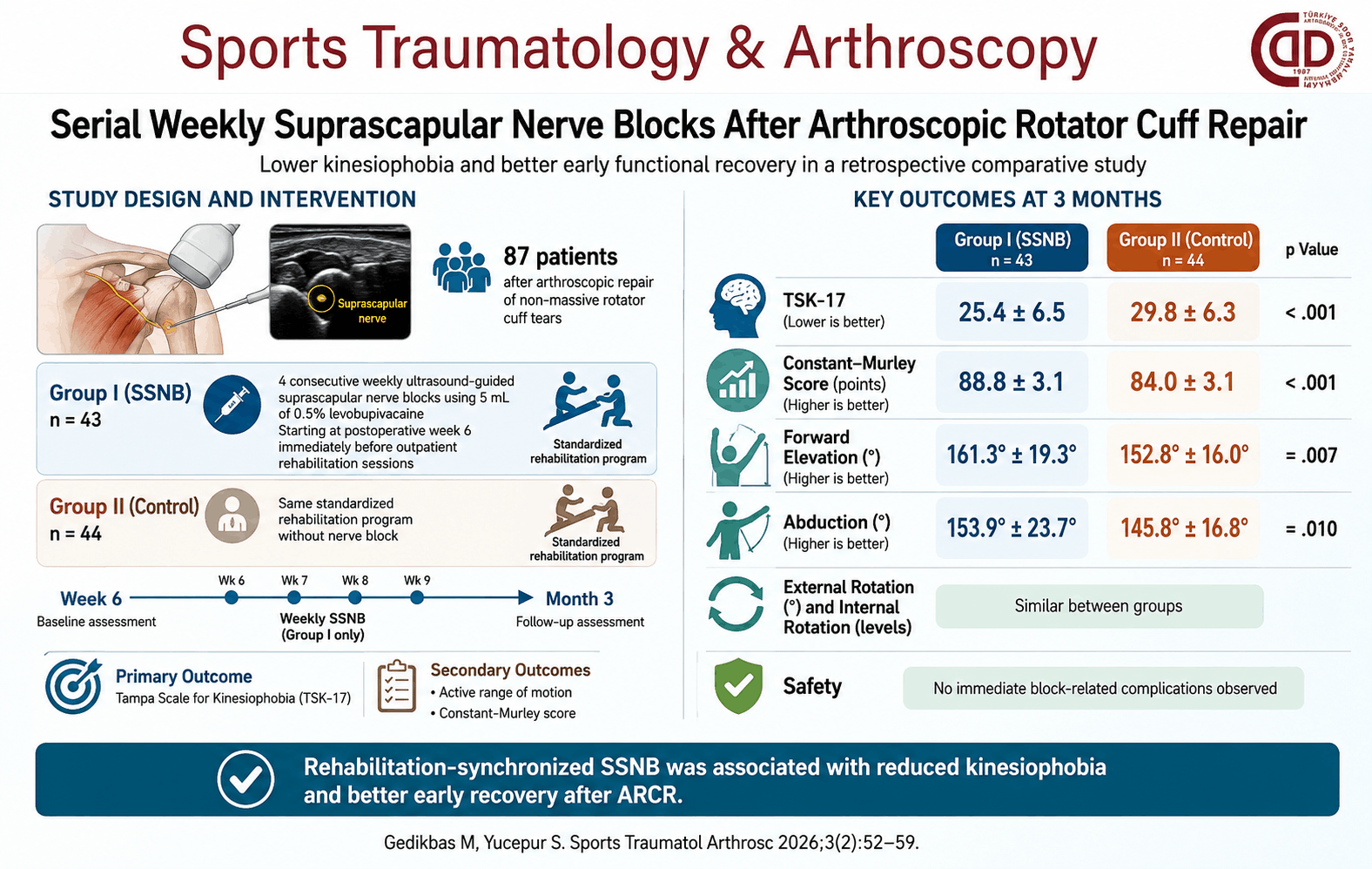
Objective: Arthroscopic rotator cuff repair (ARCR) is widely used for the surgical treatment of symptomatic rotator cuff tears. Postoperative pain during the early rehabilitation period may contribute to movement-related fear, resulting in kinesiophobia and impaired functional recovery. This study aimed to evaluate whether serial weekly ultrasound-guided suprascapular nerve blocks (SSNBs), administered in conjunction with early rehabilitation sessions, were associated with reduced postoperative kinesiophobia and improved early functional outcomes after ARCR.
Materials and Methods: This retrospective comparative study evaluated prospectively collected clinical data from 87 patients aged 18 to 75 years who underwent arthroscopic repair of non-massive rotator cuff tears between January 2025 and January 2026. Group I (n=43) received four consecutive weekly ultrasound-guided SSNBs using 5 mL of 0.5% levobupivacaine via a supraclavicular approach, beginning at the sixth postoperative week and immediately before outpatient rehabilitation sessions. Group II (n=44) underwent the same standardized rehabilitation program without SSNB. The Tampa Scale for Kinesiophobia (TSK-17) was the primary outcome measure. Secondary outcomes included active range of motion (ROM) and Constant-Murley (CM) scores. Assessments were performed at the sixth postoperative week, before the initiation of active-assisted rehabilitation, and at the third postoperative month by an independent assessor blinded to group allocation.
Results: Sixth-week baseline TSK-17, CM, and ROM measurements were comparable between the groups, although Group I patients were older, and the distribution of the affected side differed significantly between the groups. At the third postoperative month, Group I had significantly lower TSK-17 scores than Group II (25.4±6.5 vs. 29.8±6.3; p<.001) and higher CM scores (88.8±3.1 vs. 84.0±3.1; p<.001). Group I also demonstrated greater forward elevation (161.3°±19.3° vs. 152.8°±16.0°; p=.007) and abduction (153.9°±23.7° vs. 145.8°±16.8°; p=.010), whereas external and internal rotation were comparable between the groups. No immediate block-related complications were observed.
Conclusion: Serial weekly SSNBs administered immediately before outpatient rehabilitation sessions after ARCR were associated with lower kinesiophobia scores, better early functional outcomes, and greater forward elevation and abduction at the third postoperative month compared with rehabilitation alone. These findings suggest that rehabilitation-synchronized SSNB may be a useful adjunct to multimodal postoperative management; however, prospective randomized studies are needed to confirm its clinical benefit.
Graphical Abstract